Your submission has been received!





Beyond Google: Structuring Content That AI Can Reference
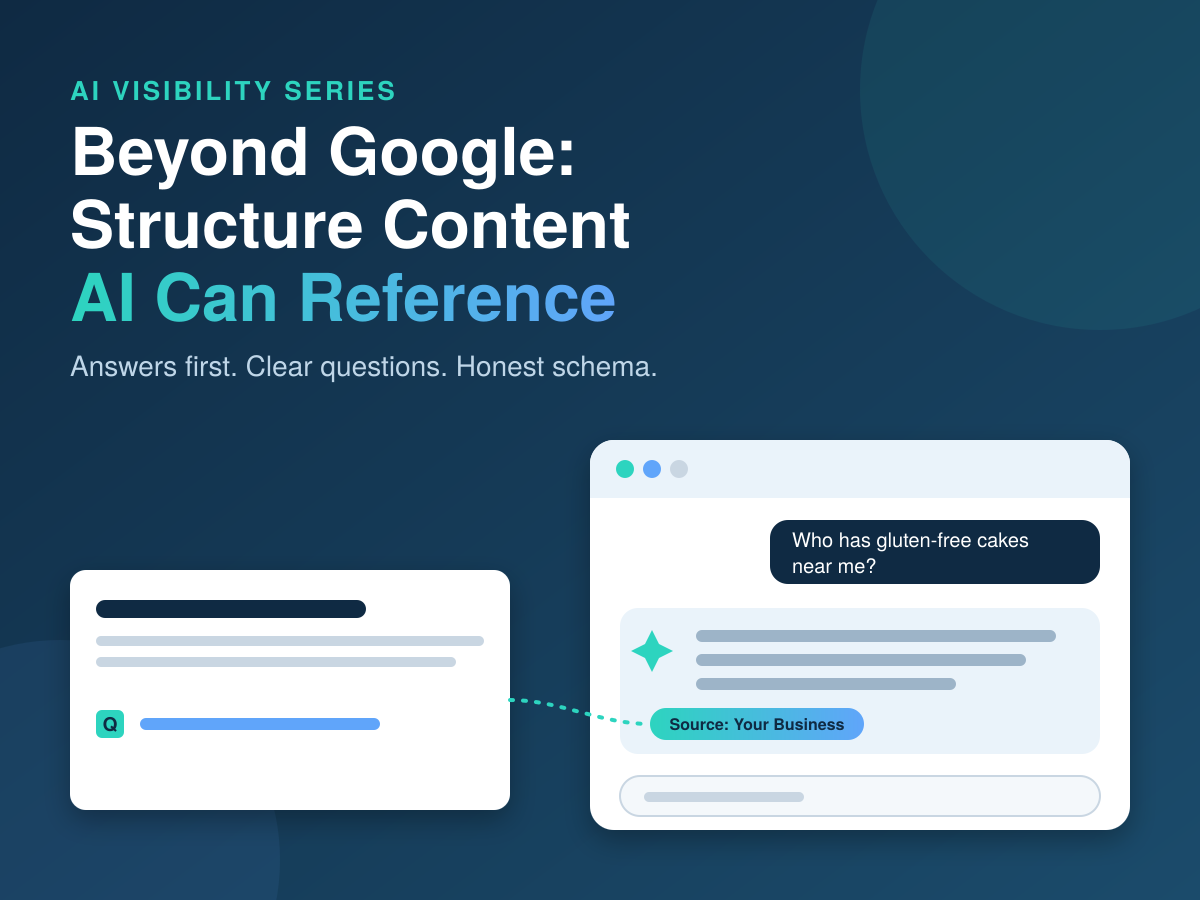
The good news is that most of what you’ll do requires little technical expertise and can be applied to content you already have. Even better, many of the fundamental principles align with established content best practices. Google’s own guidance on its AI features emphasizes that quality content performing well in traditional search also supports visibility in Google’s AI Overviews. For AI tools outside of Google’s ecosystem, like ChatGPT and Perplexity, additional strategies apply, which we’ll cover throughout this article. Let’s walk through the practical, actionable steps you can take to make your content easier for AI systems to reference.
Start With How You Answer Questions
AI tools like ChatGPT, Perplexity, and Google’s AI Overviews assemble responses by finding sources that answer questions directly. This means the structure of your content, specifically how quickly and clearly it answers common questions, matters significantly.
Put Answers Near the Top
According to Search Engine Land’s guidance on AI search optimization, structured content with clear headings and direct answers performs well in AI-generated responses. The approach they recommend: lead with the answer, then provide the context and detail below.
If your page is about winter tire maintenance for your auto shop, the answer to “how often should I check my winter tires” should appear near the top, not buried in deeper paragraphs.
This doesn’t mean abandoning storytelling or context. It means leading with the answer, then providing supporting information. Think of the first section of your page as an executive summary that AI tools can extract cleanly.
Use Question-Based Headings
Headings that match how people actually ask questions perform well in AI-generated responses. Compare these two approaches:
Traditional heading: “Winter Tire Considerations”
Question-based heading: “How Often Should You Check Your Winter Tires?”
The second format matches how customers search and how AI tools structure their responses. This applies whether you’re writing blog posts, FAQ pages, or service descriptions.
Add Structured FAQ Sections
FAQ sections are valuable content structures for AI visibility. In one test by Search Engine Land found that a page with well-implemented FAQ schema was the only one in its test group to appear in a Google AI Overview, and it also earned the group’s best organic ranking.
Why FAQs Work So Well
Many AI responses are essentially answering questions. When your content is already formatted as question-and-answer pairs, you’re providing information in the exact structure AI tools need. A well-structured FAQ makes it easier for AI to pull specific answers accurately.
How to Create Effective FAQs
Start by listing the actual questions your customers ask. These can come from live conversations, emails, phone calls, social media comments, and DMs. Then write concise, direct answers. Aim for answers that stand on their own so someone reading only that answer gets complete information without needing to read the rest of the page.
For example, a local bakery might include FAQs like:
- Do you take custom cake orders?
- How far in advance should I order a birthday cake?
- Do you offer gluten-free options?
- What are your holiday hours?
Keep answers direct and specific. Vague or promotional language performs worse than clear, factual responses.
Understanding Schema Markup
Schema markup is code that helps search engines and AI systems understand your content. Think of it as adding labels to your content so AI doesn’t have to guess what’s what.
Here’s an important nuance worth knowing: Google’s own guidance clarifies that structured data is not required for generative AI search, and there is no special schema markup needed specifically for AI Overviews. However, Google also notes that structured data remains valuable as part of your overall SEO strategy and helps search engines understand your content better.
In other words: schema markup won’t guarantee AI citations, but it does help AI systems understand and categorize your content, which can improve your visibility as a supporting signal.
The Most Important Schema Types for Small Businesses
You don't need every type of schema. Focus on the ones that matter most:
- LocalBusiness schema helps search engines and AI understand your business type, location, hours, and services
- FAQPage schema structures your FAQ content so questions and answers can be extracted easily
- Article schema identifies your blog posts as authored, dated content with clear attribution
- Review schema structures customer reviews and ratings (see the note below)
- Organization schema establishes your business as an entity across platforms
A Quick Note on Review Schema
Resist the temptation to paste your Google or Facebook reviews into your own schema to try to earn star ratings. It can actually hurt your credibility. Instead, keep collecting genuine reviews on your Google Business Profile, which is where Google and AI tools look for review signals.
How to Add Schema Without Technical Skills
If you use WordPress, plugins like Rank Math or Yoast SEO can add most schema types automatically. Squarespace, Wix, and Shopify have built-in schema for standard content types. For custom needs, you can ask AI tools like ChatGPT or Claude to generate JSON-LD schema code that you or your web person can add to your site.
Most schema is written in JSON-LD format, which is Google's recommended format. Your web developer or a knowledgeable freelancer can typically implement this in a few hours if you don't want to tackle it yourself.
Keep Schema Consistent with Visible Content
One important warning: Google’s structured data guidelines say not to mark up content that isn’t visible on the page. If your schema doesn’t match what visitors actually see, Google may ignore it or take a manual action, which means your page can lose eligibility for rich results. Make sure your schema accurately reflects what’s actually on your page.
Free and Low-Cost Tools to Help
You don't need expensive enterprise software to implement these changes. Here are accessible tools:
For Schema Markup:
- Rank Math (free WordPress plugin)
- Yoast SEO (free WordPress plugin)
- Google's Rich Results Test (free, validates your schema)
- Schema.org (free reference for schema types)
For Content Optimization:
- Google Search Console (free, shows what queries bring people to your site)
- AnswerThePublic (freemium, shows questions people ask)
- Google's "People also ask" feature in search results
For Consistency Audits:
- Google Business Profile (free)
- BrightLocal or similar listing management tools (paid, but generally more affordable than enterprise options)
- Manual audits using a simple spreadsheet
Realistic Expectations
Implementing these changes takes time, and results are gradual. AI models don't instantly notice changes to your content. Some models update their training data periodically, while others use real-time retrieval. Being cited consistently by AI tools is a longer-term outcome of building genuine authority and accessibility.
That said, these changes generally support your overall visibility across traditional Google search, Google's AI Overviews, and other platforms. You're not making changes that only benefit AI. You're improving how findable and useful your content is overall. According to Google's guidance, quality content that performs well in organic search also supports visibility in Google's AI features, and many of the same principles apply to how other AI tools evaluate and reference content.
Your Practical Starting Point
If this feels like a lot, start small. Pick one page on your website, perhaps your most-visited page or a key service page. Apply these principles to that page:
- Add clear, direct answers to common questions near the top
- Use question-based headings
- Add an FAQ section at the bottom
- Check that your business information is consistent everywhere
Once that page is optimized, move to the next. Building this incrementally is more sustainable than trying to overhaul everything at once.
Closing the Loop
Over this series, we've covered the shift in how customers find businesses, what factors influence AI citations, and practical steps to structure your content accordingly. The through-line across all three articles is that AI visibility is not magic and it is not unattainable. It's the result of intentional, ongoing work that also happens to strengthen your overall online presence.
These steps won’t guarantee citations, but they build a solid foundation. The content improvements, cross-platform presence, and credibility signals that help AI systems reference your business are the same things that make your business more findable, understandable, and trustworthy to human customers.