.svg)
.png)
Your submission has been received!

.png)
.png)
.png)

Beyond Google: How AI Is Changing the Way Customers Find Your Business
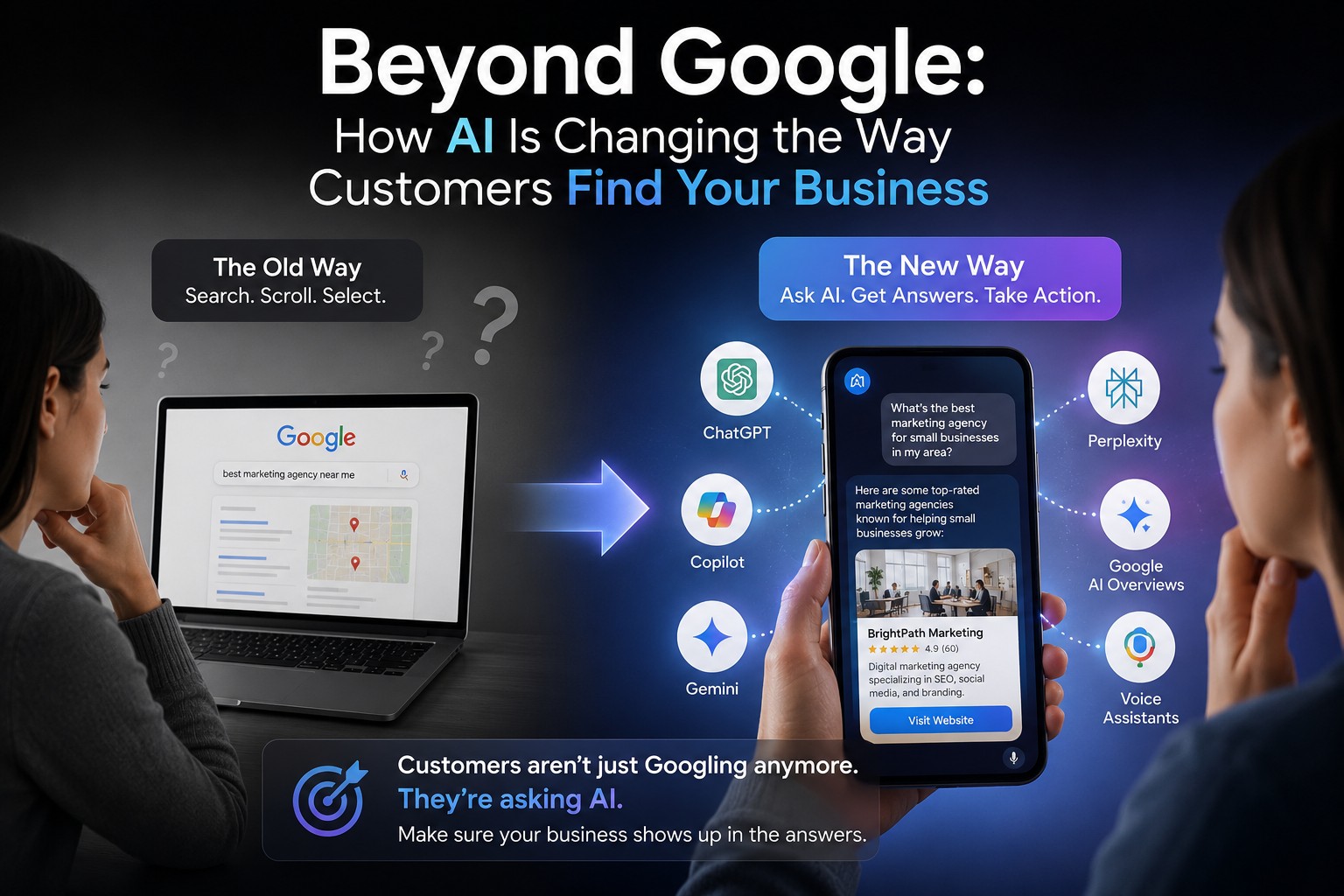
But something interesting is happening in the world of discoverability. Your future customers are increasingly turning to AI tools like ChatGPT, Perplexity, and Claude to research businesses, find recommendations, and make purchasing decisions. And here is some good news: this shift creates a massive opportunity for businesses that adapt early.
Let’s explore what this means for your business, and why those that understand this shift now will have significant advantage moving forward.
The Numbers Behind the Shift
The scale of AI-powered search adoption is remarkable, and it happened faster than anyone predicted. Chat GPT crossed 900 million weekly active users in early 2026, roughly double its count a year earlier. Even more telling, 37% of consumers now begin their searches with AI tools rather than a traditional search engine, according to 2026 data.
This is not a niche trend. AI assistants generate 45 billion sessions worldwide, equal to 56% of global search engine volume. In the United States, AI accounts for 34% of search usage. Your customers are already using these tools, though you may not realize it.
Competition is also growing. Recent research shows that ChatGPT, Claude, Gemini, and Perplexity now hold nearly 99% of measurable AI referrals combined. This is not about optimizing for one platform anymore. It is about being discoverable across the entire AI ecosystem.
What This Actually Means for Small Businesses
Traditional SEO has long favored large brands with massive budgets, extensive backlink profiles, and dedicated SEO teams. AI search operates differently, and understanding these differences can help small businesses find their footing in this new era.
As SEO expert Neil Patel explains, AI tools like ChatGPT and Perplexity don’t rank websites the way Google does. Instead, they synthesize answers from sources across the web, drawing on training data and real-time retrieval to construct responses.
The businesses that get cited by AI tend to share certain characteristics: they publish clear, well-structured content, they earn mentions from credible third-party sources, and they establish demonstrable expertise in their field. This creates three areas of opportunity for small businesses.
Opportunity 1: Authority Signals Come In Many Forms
Neil Patel notes that AI systems weigh brand authority and citations heavily when generating responses. While large brands still dominate AI citations in most industries, small businesses can build authority through consistent expert content, positive reviews, and mentions in trade publications, local media, and industry websites.
Opportunity 2: AI Traffic Tends to Convert Well
Research from NP Digital suggests that ChatGPT traffic can be significantly more valuable than typical Google traffic, with businesses reporting higher engagement, longer visits, and stronger conversion rates. One reason: when someone arrives at your business after an AI recommendation, they’ve often already done substantial research and are closer to making a decision.
Opportunity 3: Third-Party Mentions Carry Weight
Muck Rack’s May 2026 analysis found that 84% of AI citations come from earned editorial coverage in third-party publications, rather than brand-owned content or paid placements. This means investing in relationships with journalists, contributing expert commentary to industry publications, and earning organic mentions can meaningfully influence AI visibility.
The Honest Perspective On This AI Shift
AI search is not automatically easier than traditional SEO. Large, established brands still dominate AI citations in most industries because they have more content, more third-party mentions, and stronger domain authority built up over years.
At the same time, AI search does open new doors. The businesses AI systems reference tend to be those that publish clear, credible content and earn mentions from trusted sources. Small businesses that invest consistently in content quality, community relations, and industry credibility can compete for AI visibility in ways that are meaningful, even if the competition remains challenging.
Building Your AI Visibility Playbook
This article is the first in a series designed to help you understand and adapt to this shift without feeling overwhelmed. Over the coming articles, we will explore:
- How AI tools generate citations and what factors influence which sources they reference
- Practical steps to structure your content in ways that are easier for AI to reference
- The role of earned media, reviews, and third-party mentions in building AI-relevant authority
Each article will build on the last, giving you a practical roadmap for adapting as this landscape develops.
What You Can Do Right Now
Here are practical steps you can take today:
- Notice How You Personally Use AI Search
Start paying attention to how you use ChatGPT, Perplexity, Claude, or Google’s AI Overviews for your own research and decisions. Which businesses appear in responses? What kinds of sources get referenced? This firsthand awareness will help you understand what your customers may be experiencing.
- Review Your Existing Content for Clarity
AI systems tend to reference content that clearly and directly answers specific questions. Review your website, blog posts, and social content. Are you explaining what you do, who you serve, and what makes you different in clear, direct language? Well-structured, informative content tends to perform better across both traditional and AI search.
- Continue Building Real Credibility
The credibility signals that matter for AI visibility, consistent content, earned media mentions, positive reviews, industry recognition, are largely the same signals that have always mattered for local businesses. Keep showing up in your community, keep collecting reviews, and keep sharing your expertise.
The Path Forward
Traditional SEO still matters. Google isn’t going away. Your website, your Google Business Profile, and your content all remain critically important. What’s expanding is the ecosystem of places where customer discovery happens. And that expansion creates real opportunity for small businesses willing to learn how it works.
Your community is still looking for what you offer. Your future customers are simply searching in more ways than before. The good news is that many of the fundamentals haven’t changed: clear and valuable content, genuine expertise, community credibility, and consistent effort still matter. What’s shifting is how these fundamentals translate into visibility across new platforms.
In the next article, we’ll look more closely at how AI tools generate citations and what factors seem to influence which sources they reference. We’ll explore what current research tells us and what practical steps you can take to position your business as a credible source AI is more likely to cite.